
Every medicine can cause side effects, including medicines you have taken for years. A side effect is any unwanted effect a medicine has, from a mild headache to a serious allergic reaction. Most are mild and pass on their own, but some need a call to your pharmacist or doctor, and a few need emergency care. Knowing how to tell a side effect from something else, what to record, and when to get help turns a worrying symptom into a clear set of steps.
What counts as a side effect
A side effect is any unwanted effect of a medicine, whether or not the medicine caused it. Common ones include nausea, drowsiness, headache, dry mouth, and constipation. Serious ones include trouble breathing, swelling of the face or lips, a severe rash, chest pain, and fainting. The label for each medicine lists the side effects seen in trials and after approval, in the Adverse Reactions section, with the most common ones first. Reading that section before you start a medicine tells you what to watch for, and it also tells you what is expected and what is not. A symptom that is not on the label can still be a side effect, because rare effects may only show up once a medicine is used by many more people than were in the trials.
How to tell if the medicine caused it
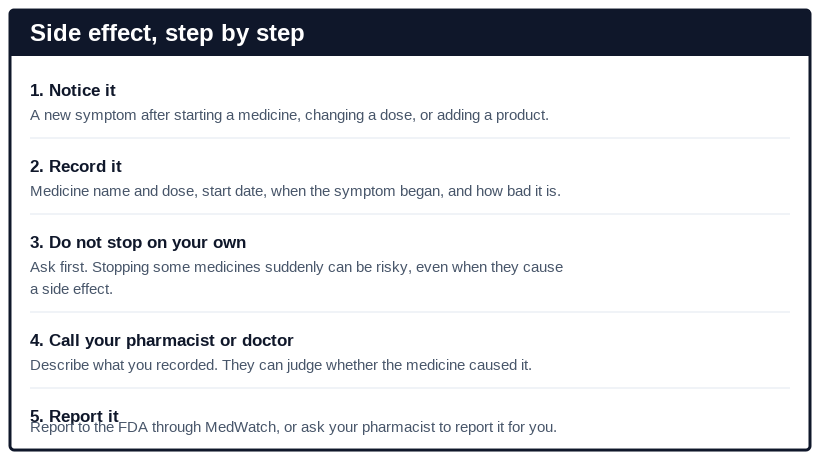
Timing is the first clue. A symptom that starts soon after a new medicine, a dose increase, or adding another product is more likely to be linked to the medicine than one that started months before. A symptom that fades when the dose is lowered, or comes back when the medicine is restarted, is another clue, but only a prescriber should test that, never the patient alone. Other causes matter too: a new illness, a change in diet, alcohol, or another medicine can cause the same symptom. The pharmacist will ask about all of these, and about your full list of medicines, before judging whether the medicine is the cause. Do not assume a symptom is a side effect, and do not assume it is not. Ask, and bring the details.
What to record
Write down six things, and keep the note where you can find it. The medicine name and dose, and the date you started it. The date the symptom began, and what it feels like. How bad it is, on a scale you can describe, such as mild, moderate, or severe. What makes it better or worse. Any other medicines, supplements, or foods you started at the same time. And what you have already tried for it. Bring the note to the pharmacist or doctor, along with the medicine bottle. A clear note turns a vague complaint into something a clinician can judge, and it also helps if the side effect needs to be reported.
Side effects are not the same as allergies
A side effect and an allergy are different things, and mixing them up can cause problems. A side effect is an unwanted effect of a medicine that can happen to anyone, such as nausea or drowsiness. An allergy is an immune reaction, and it is specific to you: a rash, hives, swelling, or trouble breathing after a medicine, especially if it happened before with the same medicine or one like it. An allergy is usually more serious, and the medicine, and others like it, should be avoided and recorded in your medical record. Tell every prescriber, pharmacist, and dentist about any drug allergy you have, and what happened when you took it. If you are not sure whether a reaction was an allergy or a side effect, say so, and let the clinician decide. Our drug allergy screener can help you check for medicines that share ingredients with one you are allergic to, but it does not replace that conversation.
When to get help fast
Some symptoms need emergency care, not a phone call. Trouble breathing or swallowing, swelling of the face, lips, or tongue, a severe rash with blistering, chest pain, fainting, or signs of a severe allergic reaction are all reasons to seek emergency help right away. The same applies to thoughts of harming yourself after starting a new medicine, and to a child who becomes unusually sleepy or hard to wake after a medicine. Do not wait to see if it passes. Call emergency services, or go to the nearest emergency department, and take the medicine bottle with you. For anything less urgent, such as persistent nausea, a rash that is spreading, or a side effect that stops you taking the medicine, call your pharmacist or doctor the same day.
Reporting it helps everyone
Reporting a side effect helps the next person who takes the same medicine. Trials test a medicine in thousands of people, but rare side effects may only appear once millions use it, and regulators learn about them from reports. In the United States, anyone can report a side effect to the FDA through MedWatch, the FDA Safety Information and Adverse Event Reporting Program, online or by phone. Your pharmacist or doctor can also report it for you. The report asks for the medicine, the dose, the symptom, and when it happened, which is why the note you kept matters. A report does not prove the medicine caused the symptom, and it does not replace medical advice. It adds one more piece to the safety record, and that record is how labels get updated and how unsafe medicines are found.
Frequently asked questions
Try the tools on this site
Muhammad Kashif
Muhammad Kashif runs RxTools Pro. He is not a pharmacist, and this site does not present him as one. He writes these guides from published references, and every factual claim links to its source. The tools and articles on this site are for general information and learning, not personal medical advice.
Sources
- MedlinePlus, Drug Safety
- FDA, MedWatch: The FDA Safety Information and Adverse Event Reporting Program
- NHS, Medicines Information
Related posts
What a Drug Interaction Checker Can and Cannot Tell You
What a checker can catch, what it cannot see, and why a clear result is not a safety guarantee.
How to Read a Drug Label, Section by Section
Learn the sections of the Drug Facts panel and the full prescribing information, and the five things to check before you take any medicine.
How to Use a Pill Identifier Safely
A loose tablet with no packaging is a question, not a medicine. Learn how to read a pill, what a match really means, and when not to trust the result.
Drugs in Pregnancy by Trimester: What Changes and Why
What changes between trimesters, why the first needs extra care, and how the FDA's PLLR labeling replaced the old letter categories.