Every medicine you buy carries a label that tells you what it is, what it does, and how to use it safely. The label is not marketing copy. In the United States, the Food and Drug Administration requires a standard format for over-the-counter medicines, so the same facts appear in the same order on every box. Prescription medicines carry a longer label called the full prescribing information. Learning to read both takes a few minutes, and it pays off every time you start a new medicine.
The two labels you will meet
Over-the-counter medicines, the ones you buy without a prescription, carry a Drug Facts panel on the box. Prescription medicines carry the full prescribing information, a longer document that pharmacists and doctors use. The two look different, but they answer the same questions: what is in this medicine, what does it do, who should not take it, and how should it be used. The full text of US prescription labels is published on DailyMed, the National Library of Medicine database of FDA labels, where anyone can read the exact wording for any approved medicine.
The Drug Facts panel, section by section
The FDA requires the Drug Facts panel to list the same sections in the same order on every over-the-counter product. Once you know the order, you can find any fact in seconds.
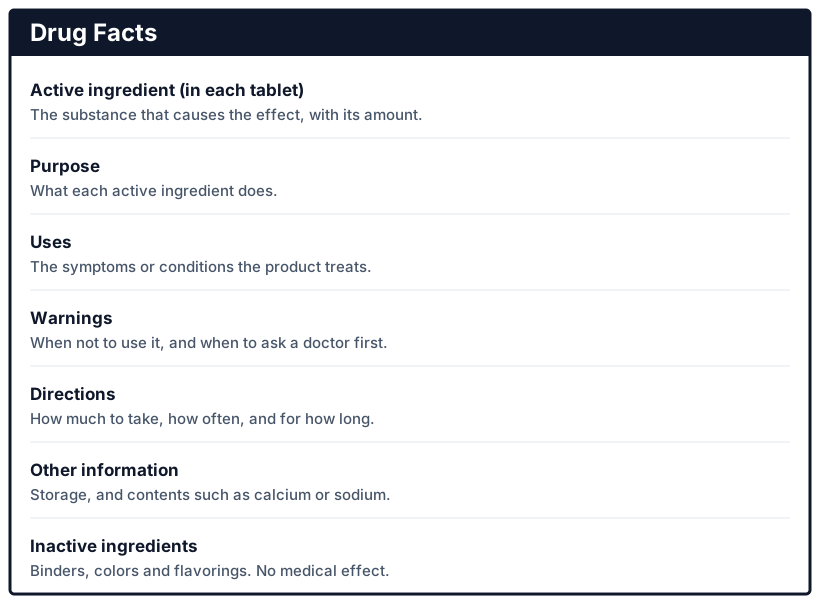
- Active ingredient(s). The substance in the product that causes the intended effect, with the amount in each dosage unit, such as one tablet or one teaspoon.
- Purpose(s). What each active ingredient does, for example pain reliever, fever reducer, or nasal decongestant.
- Use(s). The symptoms or conditions the product treats.
- Warning(s). When not to use the product, conditions that call for asking a doctor first, possible interactions and side effects, when to stop taking it and when to contact a doctor, pregnancy and breastfeeding warnings, and a reminder to keep the product out of the reach of children.
- Directions. How much to take, how to take it, how often, and how long. Directions are often grouped by age, so find the group that applies to you.
- Other information. How to store the product, and details such as the amount of calcium, potassium, or sodium it contains.
- Inactive ingredients. Binders, colors, and flavorings that hold the product together or make it taste better. They have no medical effect, but they matter if you have an allergy to one of them.
Dietary supplements are not covered by these rules. They are regulated as food products and carry a Supplement Facts panel instead of a Drug Facts panel.
What else the package tells you
Outside the Drug Facts panel, the package carries the statement of identity (the name, purpose, and strength of the active ingredient), the net quantity of contents, the expiration date, a lot or batch code, and the name and address of the manufacturer, packer, or distributor. The expiration date is a hard limit: do not use a product past it. If a product has no expiration date on the label, the FDA says the drug should be considered expired three years after purchase.
Reading a prescription label
The full prescribing information for a prescription medicine follows a fixed set of sections. The main ones are:
- Boxed Warning. The most serious risks, printed in a box at the top.
- Indications and Usage. The conditions the medicine is approved to treat.
- Dosage and Administration. The dose, how it is given, and how it changes for age, weight, or kidney and liver function.
- Contraindications. Situations where the medicine must not be used.
- Warnings and Precautions. Risks to watch for and situations that call for care.
- Adverse Reactions. Side effects seen in trials and after approval.
- Drug Interactions. Medicines, foods, and supplements that can change how this medicine works.
- Use in Specific Populations. Pregnancy, breastfeeding, children, and older adults.
- How Supplied / Storage and Handling. The forms and strengths available, including the tablet's imprint, shape, color, and size, plus storage instructions.
The leaflet folded into the box is a short summary, not the full label. For the full text, look the medicine up on DailyMed. That is also where our pill identifier gets its imprint data: the How Supplied section lists the exact markings on each tablet and capsule.
Five things to check before you take any medicine
- Name and strength. Check that the name and strength match what was prescribed or what you meant to buy. Brand and generic versions of the same medicine contain the same active ingredient, but the names on the box can differ, so read the active ingredient line, not just the brand.
- Expiry date. Do not use a product past its date, and treat a product with no date as expired three years after purchase.
- Directions for your group. Find the age or weight group that applies to you and follow its dose, not another group's.
- Warnings that apply to you. Read the Warnings section for other medicines you take, conditions you have, and pregnancy or breastfeeding.
- Changes since last time. Manufacturers sometimes change ingredients, dosages, or warnings, and many products have similar brand names with different active ingredients. Read the label each time you use a product, and look for flags or banners on the front of the package that announce a change.
Where to read the full label
DailyMed publishes the full FDA label for every approved medicine in the United States. MedlinePlus offers plain-language drug information written for patients, and the NHS Medicines A to Z covers medicines available in the United Kingdom. Start with the label, and use the plain-language pages when the label's wording is hard to follow.
Frequently asked questions
Try the tools on this site
Muhammad Kashif
Muhammad Kashif runs RxTools Pro. He is not a pharmacist, and this site does not present him as one. He writes these guides from published references, and every factual claim links to its source. The tools and articles on this site are for general information and learning, not personal medical advice.