
If you take more than one medicine, the combination matters as much as each medicine on its own. A drug interaction checker compares the medicines you enter against a database of known pairs and flags the ones that can clash. It is a useful first check. It is not a full safety review, and understanding what it cannot see matters more than the result it gives you.
What a drug interaction is
A drug interaction happens when one substance changes how another works. Interactions fall into three broad groups. Drug-drug interactions happen when two or more medicines react with each other. Drug-food and drink interactions happen when food or alcohol changes how a medicine is absorbed or broken down. Drug-condition interactions happen when a medical condition makes a particular medicine risky for you. Even medicines that are safe on their own can cause side effects or interactions with food, alcohol, or other medicines, and some medicines are not safe during pregnancy. That is why the list of what you take matters as much as any single product.
What our checker does
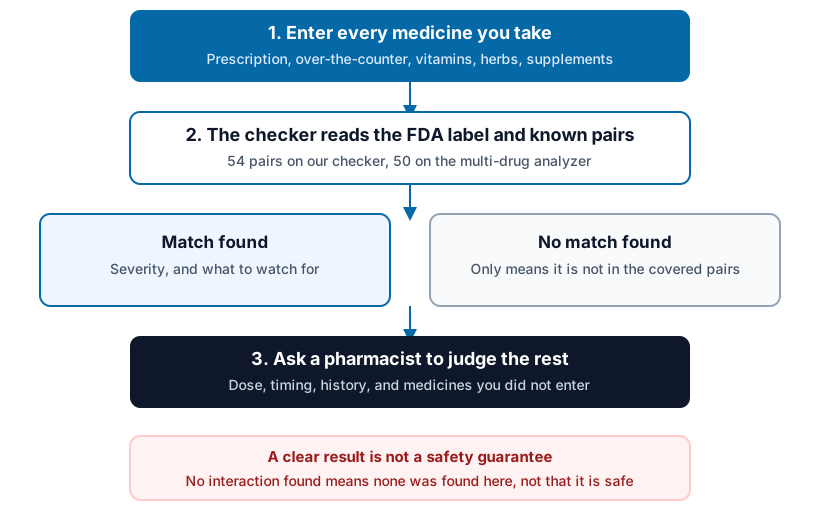
You enter two or more medicines, and the checker reads the official FDA label for each one, then compares them against its database of known pairs. Our drug interaction checker covers 54 pairs, and the multi-drug analyzer covers 50 pairs, with autocomplete across 143 medications. The same category also has tools for alcohol, food, and supplement interactions, because those are separate checks, not the same one. When the checker finds a match, it shows the severity and a short explanation of what happens and what to watch for. You can run the check in seconds, with no account, and repeat it whenever your list changes.
What it cannot see
A checker only knows what you type into it, and only what its database holds. It cannot see:
- Your doses, or the timing between doses. The same pair can be harmless at one dose and risky at another, and spacing two medicines hours apart can change the result.
- Your medical history. Kidney and liver function, age, weight, pregnancy, allergies, and other conditions all change how a medicine behaves, and a checker does not know any of them.
- Medicines you did not enter. Over-the-counter products, vitamins, herbal products, and dietary supplements count as medicines, and a checker cannot flag what it was never told about.
- Interactions that are not in its database yet. Newer medicines and rare combinations may not be covered, and no database holds every possible pair.
- Food and alcohol. Those need their own checks, because they are separate from drug-drug pairs.
Most important is what a clear result means. "No interaction found" means no interaction was found among the pairs this checker covers. It does not mean the combination is safe. It means the check came back clear within its limits.
Why dose and timing matter
Two medicines can be safe together at low doses and risky at higher ones. Some pairs are only a problem when taken at the same time, and taking them hours apart removes the clash. Others build up over days, so the risk appears only after a week of combined use. A checker that only looks at names cannot judge any of that. That is why the label for each medicine lists interactions alongside doses and timing, and why a pharmacist asks how much you take and when you take it.
What to do instead of guessing
Make a full list of everything you take, including prescription medicines, over-the-counter products, vitamins, herbal products, and dietary supplements, and show it to your pharmacist or doctor. Ask three questions: can I take these together, should I avoid certain foods, drinks, or other products, and what should I watch for. Use the checker first to spot the obvious clashes, then let the pharmacist judge the rest. If you start a new medicine, re-run the check with the full list, and read the Drug Interactions section of the new label.
Frequently asked questions
Try the tools on this site
Muhammad Kashif
Muhammad Kashif runs RxTools Pro. He is not a pharmacist, and this site does not present him as one. He writes these guides from published references, and every factual claim links to its source. The tools and articles on this site are for general information and learning, not personal medical advice.