
Pregnancy changes how medicines behave, and it changes what is at stake. A medicine that is safe for the mother can still reach the baby, and the effect depends on when in pregnancy it is taken. That is why the same medicine can carry a different risk in the first trimester, the second, and the third, and why the advice is never a single yes or no. This guide explains what changes between trimesters, how the FDA now describes pregnancy risk on labels, and how to make the decision with your doctor.
Why trimester matters
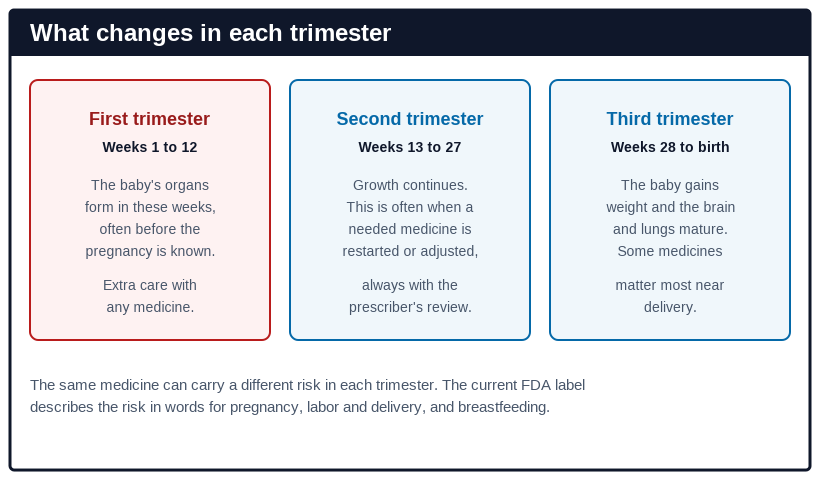
Pregnancy lasts about 40 weeks, and the baby develops on a schedule. In the first trimester, the organs form, and the structures that will become the heart, brain, spine, and limbs take shape. In the second trimester, the baby grows and the organs mature. In the third, the baby gains weight and the brain and lungs finish developing, and medicines taken near delivery can affect the newborn directly. The mother's body changes too: blood volume rises, the kidneys clear medicines faster, and the liver handles them differently, so a dose that worked before pregnancy may need adjusting. Because the risks differ by stage, the label for each medicine now describes pregnancy, labor and delivery, and breastfeeding in separate sections, instead of giving one overall verdict.
The first trimester: extra care
The first trimester needs the most care, because the organs form in the first weeks, often before the pregnancy is known. That is why health authorities advise planning ahead: the CDC recommends 400 micrograms of folic acid each day for women who could become pregnant, starting before conception, because folic acid lowers the risk of neural tube defects. If you take regular medicines and are planning a pregnancy, talk to your doctor before you try to conceive, so any medicine that needs changing can be reviewed in advance. Stopping a needed medicine on your own can be risky: untreated epilepsy, asthma, depression, and high blood pressure all carry risks in pregnancy too. The decision is always a balance between the risk of the medicine and the risk of the untreated condition.
The second trimester
The second trimester is often the most stable period of pregnancy, and it is when a needed medicine is commonly restarted or adjusted after a first-trimester pause. Growth continues, and the organs that formed in the first trimester mature. Some medicines are safer to use now than in the first weeks, but that is a decision for the prescriber, not a general rule. Any new medicine in the second trimester still needs a review, and the dose may need adjusting as the mother's blood volume and kidney function change. Keep a list of everything you take, including over-the-counter products, vitamins, and herbal products, and bring it to every appointment.
The third trimester
In the third trimester, the baby gains weight and the brain and lungs mature, and medicines taken near delivery can affect the newborn. The FDA has warned that NSAIDs taken after about 20 weeks of pregnancy can cause rare but serious kidney problems in the unborn baby, and can lead to low amniotic fluid. Some medicines taken late in pregnancy can cause withdrawal symptoms in the newborn, or affect breathing at birth, so the prescriber may plan the dose and the timing around the due date. Labor and delivery have their own section on the label, because medicines given during labor, including pain relief, reach the baby at birth. If a medicine is needed in the third trimester, the prescriber weighs the benefit to the mother against the risk to the baby, and plans monitoring for both.
The old letter categories are gone
Until 2015, the FDA sorted medicines into pregnancy letter categories: A, B, C, D, and X. The letters looked simple, and that was the problem. A letter could not explain the risk, and the same letter could mean very different things for different medicines. In 2015, the FDA replaced the letters with the Pregnancy and Lactation Labeling Rule, known as PLLR. Labels now carry a narrative Pregnancy section with a risk summary, clinical considerations, and the data behind it, plus separate sections for lactation and for women and men of reproductive potential. Old letters still appear in older references and on some websites, but they are not current. Our pregnancy checker uses the current PLLR framing, and its lookup lists the legacy category only where one was assigned before 2015. One change worth knowing: the FDA removed the contraindication for statins in pregnancy in July 2021. Statin labels now say to stop the statin when pregnancy is recognized, or to consider the ongoing needs of patients at very high risk. Statins are no longer listed as Category X.
Breastfeeding after birth
After birth, the question changes from the placenta to breast milk. Many medicines pass into breast milk, usually in small amounts, and the amount depends on the medicine, the dose, and the timing of the feed. LactMed, the National Library of Medicine database on drugs and lactation, is the reference pharmacists use to check a medicine against breastfeeding. For most medicines, the prescriber weighs the benefit of the medicine to the mother against the amount the baby would receive. Some medicines call for timing the feed around the dose, and a few call for stopping breastfeeding while the medicine is taken. Our breastfeeding checker covers 30 commonly used medicines with the same PLLR framing. Tell your doctor and pharmacist that you are breastfeeding before starting any new medicine, including over-the-counter products.
Frequently asked questions
Try the tools on this site
Muhammad Kashif
Muhammad Kashif runs RxTools Pro. He is not a pharmacist, and this site does not present him as one. He writes these guides from published references, and every factual claim links to its source. The tools and articles on this site are for general information and learning, not personal medical advice.
Sources
- FDA, Pregnancy and Lactation Labeling Resources
- MedlinePlus, Pregnancy
- DailyMed, National Library of Medicine
Related posts
How to Read a Drug Label, Section by Section
Learn the sections of the Drug Facts panel and the full prescribing information, and the five things to check before you take any medicine.
What to Do When a Medicine Causes Side Effects
How to tell if a medicine caused a symptom, what to record, and when to get help fast.
Pediatric Dosing Safety: Why Children Are Not Small Adults
Why a child's dose is worked out from weight and age, not by cutting an adult dose in half, and how to measure a liquid dose correctly.
How to Use a Pill Identifier Safely
A loose tablet with no packaging is a question, not a medicine. Learn how to read a pill, what a match really means, and when not to trust the result.