
A child is not a small adult, and a child's dose is not an adult dose cut in half. Children handle medicines differently from adults: their livers and kidneys are still maturing, their bodies hold different amounts of water and fat, and the way they absorb and clear a medicine changes as they grow. That is why a dose that is right for an adult can be wrong for a child, and why a dose that is right for a child today can be wrong for the same child next year. This guide explains how children's doses are worked out, where mistakes happen, and how to measure a liquid dose correctly.
Why children are not small adults
Children's bodies are still developing, and that changes how medicines work in them. In newborns and infants, the liver enzymes that break medicines down and the kidneys that clear them are not yet working at full capacity, so some medicines stay in the body longer. In older children, the opposite can happen: a child can clear some medicines faster than an adult, per kilogram of body weight. Body composition matters too. Young children carry more water per kilogram than adults, and the amount of body fat changes with age, which changes how a medicine spreads through the body. Age also changes how a medicine is absorbed: stomach acid, gut movement, and the thickness of the skin all differ between a baby, a toddler, and a teenager. Because of all this, prescribers do not scale adult doses down by age alone. They work from the child's weight, the child's age, and what is known about that particular medicine in children. Some medicines have never been studied in children at all, which is why the label may say the safety and effectiveness in children have not been established. When that is the case, the prescriber weighs the need for the medicine against the lack of data, and the pharmacist checks the dose against published pediatric references.
How a child's dose is usually worked out
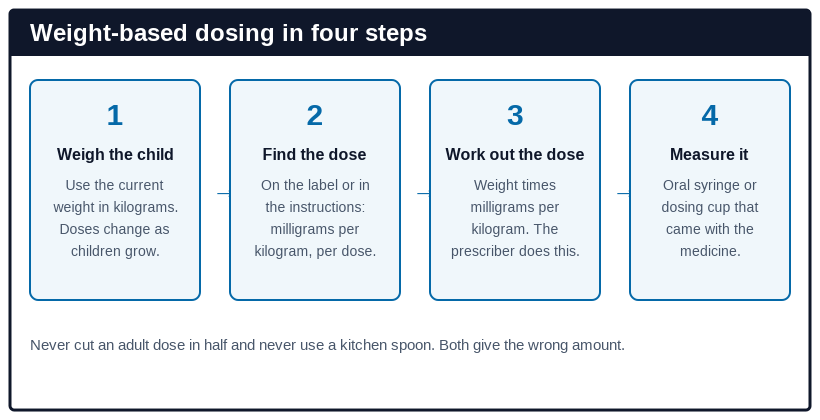
Most children's doses are worked out from body weight. The label or the pediatric reference gives a dose in milligrams per kilogram of body weight, per dose, and the prescriber multiplies that by the child's current weight. A child who weighs 15 kilograms and needs 10 milligrams per kilogram gets 150 milligrams per dose. The dose is checked against a maximum, often the adult dose, so a large teenager does not get more than an adult would. Age bands appear on over-the-counter labels instead of weight, because parents at home cannot always weigh a child before every dose. Those bands are a rough guide, and the label usually says to ask a doctor for children under a certain age. Weight is the more exact measure, which is why the prescriber asks for a current weight at every visit, and why the dose often changes as the child grows. A dose that was right six months ago can be too low now. Parents should never adjust the dose themselves when the child gains weight. The prescriber recalculates it, and the pharmacist double-checks it against the weight on the prescription.
The mistakes that cause most dosing errors
Most dosing errors in children come from a small set of mistakes, and all of them are avoidable. The first is using a kitchen spoon. Household spoons hold different amounts, and a tablespoon can hold twice as much as a teaspoon, so a dose measured with one is a guess. The second is guessing from an adult dose. Cutting an adult tablet in half, or giving a child a smaller amount of an adult liquid, ignores the way children handle medicines and can give too much or too little. The third is giving two products with the same active ingredient at once. Many cold and pain medicines contain paracetamol, also called acetaminophen, and giving two of them together doubles the dose without anyone noticing. The fourth is not shaking a liquid medicine. Some liquids settle, so the first dose from the bottle can be weak and the last dose too strong. The fifth is mixing up units. Milligrams and millilitres are not the same thing, and a dose written as 5 mL is not the same as 5 mg. Reading the label slowly, and asking the pharmacist to confirm the dose and the measuring device, catches all five.
Measuring a liquid dose correctly
Use the measuring device that comes with the medicine: an oral syringe, a dosing spoon, or a dosing cup marked in millilitres. Shake the bottle first if the label says to. Draw the liquid into the syringe or pour it into the cup, then hold it at eye level and check the amount against the mark. Give the dose slowly, a little at a time, so the child can swallow it. If the child spits some out, do not guess a second dose. Call the pharmacist and ask what to do, because giving more can mean an overdose. Keep a note of the time of each dose, so a missed dose is not repeated by mistake. Store the medicine where the label says, and keep all medicines out of the reach of children, even when the cap is child resistant. Child-resistant caps slow a child down. They do not stop a determined child.
What to ask the pharmacist
Before you leave the pharmacy, ask five questions. What is the dose, and how was it worked out from my child's weight? What device should I use to measure it? How should the medicine be stored? What should I do if my child misses a dose, or vomits after taking it? And what side effects should I watch for? The pharmacist can also check whether the dose on the prescription matches the child's weight, whether any other medicine the child takes interacts with it, and whether the liquid needs shaking or refrigeration. Bring the child's current weight and a list of everything the child takes, including over-the-counter products and vitamins. A pharmacist would rather answer the same question twice than see a child get the wrong dose once.
Frequently asked questions
Try the tools on this site
Muhammad Kashif
Muhammad Kashif runs RxTools Pro. He is not a pharmacist, and this site does not present him as one. He writes these guides from published references, and every factual claim links to its source. The tools and articles on this site are for general information and learning, not personal medical advice.
Sources
- MedlinePlus, Medicines and Children
- HealthyChildren.org, Medication Safety
- NHS, Medicines Information
Related posts
How to Read a Drug Label, Section by Section
Learn the sections of the Drug Facts panel and the full prescribing information, and the five things to check before you take any medicine.
Drugs in Pregnancy by Trimester: What Changes and Why
What changes between trimesters, why the first needs extra care, and how the FDA's PLLR labeling replaced the old letter categories.
eGFR and Kidney Dosing Explained: What Your Number Means for Your Medicines
What eGFR measures, why the 2021 equation no longer uses race, and why drug doses still follow creatinine clearance.
How to Read a Prescription: Sig Codes, Doses and Directions Explained
The parts of a prescription and the sig codes, translated line by line.