
A prescription is written in shorthand. Latin abbreviations, numbers, and a few lines of small print carry everything the pharmacist needs: who the medicine is for, what it is, how to take it, and how much to give. Patients are rarely taught to read it, and that is a gap worth closing. If you can read your own prescription, you can catch a wrong strength, a wrong quantity, or a direction you do not understand, before you leave the counter.
The parts of a prescription
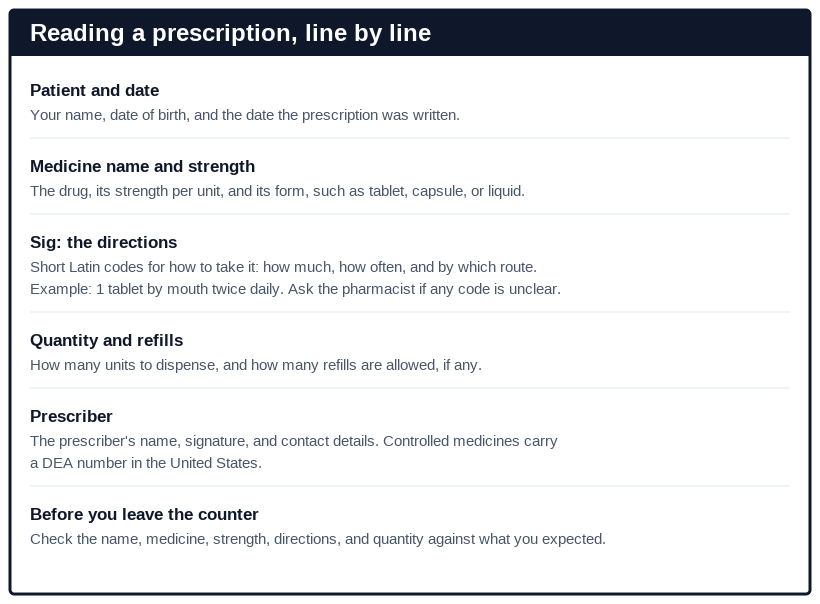
A prescription has five parts, and they always appear in the same order. First, the patient and the date: your name, date of birth, and the date the prescription was written. Second, the medicine: its name, its strength per unit, and its form, such as tablet, capsule, or liquid. Third, the sig, short for the Latin signa, meaning write: the directions for how to take it. Fourth, the quantity and refills: how many units to dispense, and how many refills are allowed. Fifth, the prescriber: name, signature, and contact details. Controlled medicines in the United States also carry a DEA number, which identifies the prescriber as licensed to prescribe them. If any part is missing or hard to read, the pharmacist will call the prescriber to confirm it, and the prescription will not be filled until the question is answered.
Sig codes, translated
The sig is where most of the shorthand lives. These codes come from Latin, and they are still used on paper prescriptions and in electronic systems. The most common ones are: qd, once daily; bid, twice daily; tid, three times daily; qid, four times daily; qhs, at bedtime; q4h, every four hours; prn, as needed; ac, before meals; pc, after meals; po, by mouth; and top, applied to the skin. A few need care. The code qd is discouraged by safety bodies because it can be misread as qid, four times daily, so many prescribers now write daily instead. The code qhs is also discouraged in some settings for the same reason. If a code on your prescription is unclear, ask the pharmacist to translate it. Do not guess. A wrong reading of a sig code can mean four doses a day instead of one.
Dose and quantity
The strength on a prescription is the amount of active ingredient in each unit, such as 10 mg per tablet or 5 mg per 5 mL of liquid. The quantity is the number of units to dispense, and it should match the days supply: the number of days the prescription is meant to last. A prescription for one tablet twice daily for 30 days should say quantity 60. If the quantity and the days supply do not match, ask the pharmacist. Check the strength too. Many medicines come in several strengths, and a prescription written for 10 mg tablets should not be filled with 20 mg tablets. The NDC number, the National Drug Code printed on the package, identifies the exact product, maker, and package size, and the pharmacist uses it to confirm the right product was dispensed.
Refills and expiry
Refills are the number of times the prescription can be filled again without a new prescription. The prescriber decides this, and can write zero refills. Some medicines cannot be refilled at all: under US federal law, Schedule II controlled substances, such as many strong pain medicines and stimulants, cannot be refilled, and a new prescription is needed each time. Schedule III to V medicines can be refilled up to five times within six months. Prescriptions also expire. In most states, a non-controlled prescription is good for one year from the date written, and the pharmacist will tell you when it has run out. Keep track of your refills, and ask for a new prescription before the old one expires, not after.
Electronic prescriptions
Most prescriptions today are sent electronically, straight from the prescriber's system to the pharmacy. You may never see the paper at all, and the sig codes may never reach you in writing. The printed label on the bottle is then the directions you follow, and it should match what the prescriber told you. If the label says something different from what you expected, ask the pharmacist before you take the first dose. Electronic prescribing cuts down on handwriting errors, but it does not remove them: the wrong strength or the wrong patient can still be selected from a drop-down list. The check at the counter matters just as much with an electronic prescription as with a paper one, and the five things to check are the same.
Before you leave the counter
Before you leave the pharmacy, check five things. Your name on the label. The medicine name and strength against what the prescriber told you. The directions, and whether they match what you understood. The quantity, and the number of refills. And the label's warnings, such as take with food or avoid alcohol. Ask the pharmacist to read the directions back to you, and to explain any code you do not recognize. If anything differs from what you expected, say so before you pay and leave. A pharmacist would rather recheck a prescription at the counter than after a wrong dose has been taken.
Frequently asked questions
Try the tools on this site
Muhammad Kashif
Muhammad Kashif runs RxTools Pro. He is not a pharmacist, and this site does not present him as one. He writes these guides from published references, and every factual claim links to its source. The tools and articles on this site are for general information and learning, not personal medical advice.
Sources
- FDA, National Drug Code Directory
- FDA, The Over-the-Counter Drug Facts Label
- NHS, Medicines Information
Related posts
How to Read a Drug Label, Section by Section
Learn the sections of the Drug Facts panel and the full prescribing information, and the five things to check before you take any medicine.
How to Use a Pill Identifier Safely
A loose tablet with no packaging is a question, not a medicine. Learn how to read a pill, what a match really means, and when not to trust the result.
What a Drug Interaction Checker Can and Cannot Tell You
What a checker can catch, what it cannot see, and why a clear result is not a safety guarantee.
How to Lower Your Medication Costs Without Skipping Doses
Generics, price comparison, help paying, and a pharmacist review: the safe ways to cut the cost.