
If you have had a blood test for kidney function, you have probably seen the letters eGFR on the result. eGFR stands for estimated glomerular filtration rate, and it is the main number doctors use to judge how well your kidneys filter blood. The number matters for medicines because the kidneys clear many drugs from the body, and when they work more slowly, a dose that was safe before can build up. This guide explains what eGFR measures, what the number means, and how prescribers use it when they set a dose.
What eGFR measures
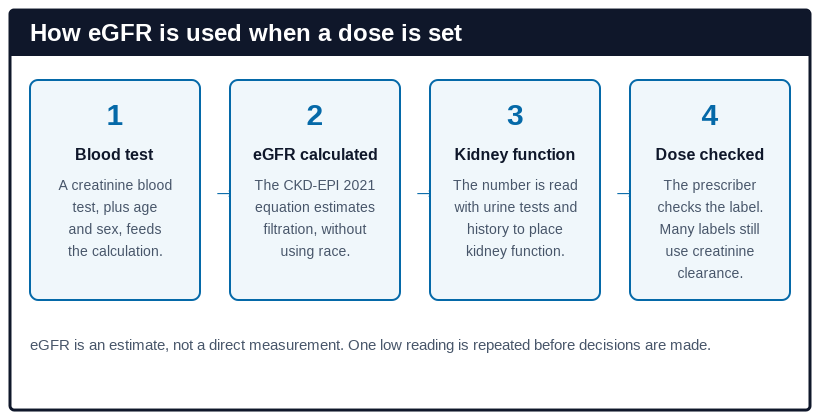
The glomeruli are tiny filters in the kidneys, and the filtration rate is how much blood they clean each minute. Measuring that rate directly is hard, so it is estimated from a blood test for creatinine, a waste product from muscle, together with your age and sex. The result is given in millilitres per minute per 1.73 square metres of body surface area, which adjusts for body size. An eGFR of 90 or above, with no other signs of kidney damage, is generally read as normal. Lower numbers point to reduced kidney function, and the number is read together with urine tests that look for protein and blood, and with your medical history. eGFR is an estimate, not a direct measurement, and it is less reliable when creatinine itself is unstable, such as during an acute illness.
The CKD-EPI 2021 equation
The most widely used way to calculate eGFR today is the CKD-EPI 2021 equation, published by the Chronic Kidney Disease Epidemiology Collaboration. It uses creatinine, age, and sex, and it no longer uses race. Earlier equations included a race variable, and in 2021 the National Kidney Foundation and the American Society of Nephrology recommended removing it, because race is a social category, not a biological one, and the variable made the estimate less accurate for many patients. Laboratories have been moving to the 2021 equation since then, so an eGFR reported today may differ slightly from one reported a few years ago for the same person. That change is expected, and it does not by itself mean kidney function has changed.
eGFR vs creatinine clearance
eGFR and creatinine clearance sound like the same thing, and they are related, but they are not interchangeable. Creatinine clearance is an older estimate, usually calculated with the Cockcroft-Gault equation from 1976, which uses creatinine, age, weight, and sex, and gives a result in millilitres per minute, without adjusting for body surface area. It was the standard when most drug labels were written, so most labels that give dose advice for kidney disease still specify creatinine clearance bands, not eGFR. eGFR is the standard for staging chronic kidney disease. A prescriber may therefore use eGFR to judge kidney health and creatinine clearance to set the dose, and the two numbers can differ, especially in people who are very large, very small, or older. That is one reason a dose decision is a clinical judgment, not a number read off a chart.
How kidney function changes a dose
Many medicines leave the body through the kidneys, either unchanged or as breakdown products. When the kidneys work more slowly, those medicines clear more slowly, and the same dose can build up to levels that cause side effects. Prescribers handle this in three ways: lowering the dose, spacing doses further apart, or choosing a different medicine that does not depend on the kidneys. Some medicines are avoided entirely when kidney function is low, because the risk outweighs the benefit. The label for each medicine carries the dose advice, usually in the Dosage and Administration section and the Use in Specific Populations section, and it is written in terms of creatinine clearance. That is why a pharmacist who checks a dose asks for your kidney function, not just your list of medicines.
Medicines that need a kidney check
Some medicines need a kidney check before they are started, and while they are taken. Metformin, a common diabetes medicine, is not started when eGFR is below 30, and it is stopped during an acute illness that can affect the kidneys, because the risk of a rare but serious complication rises when the kidneys cannot clear it. NSAIDs, the pain medicines that include ibuprofen and naproxen, can reduce kidney function, so they are used with care when eGFR is low, and avoided when it is very low. Blood pressure medicines that act on the kidneys, such as ACE inhibitors and ARBs, also need monitoring, because they change how the kidneys handle salt and water. This is not a list to act on alone. It is the reason a prescriber asks for a recent kidney function result before starting or changing a medicine, and why the pharmacist checks it again at the counter.
What makes the number move
eGFR can move for reasons that have nothing to do with lasting kidney damage. Dehydration raises creatinine and lowers eGFR. An acute illness, a recent hard workout, a high-protein meal, and some medicines can all shift the number. Muscle mass matters too: a person with very little muscle makes less creatinine, so eGFR can look better than kidney function really is, and a very muscular person can look worse. That is why a single low reading is repeated before any decision is made, and why the number is read with urine tests and history. During acute kidney injury, when creatinine is rising fast, eGFR is not reliable at all, and dosing decisions are made with extra care. If your eGFR changes between tests, ask your doctor what else was going on at the time, rather than reading the number alone.
Frequently asked questions
Try the tools on this site
Muhammad Kashif
Muhammad Kashif runs RxTools Pro. He is not a pharmacist, and this site does not present him as one. He writes these guides from published references, and every factual claim links to its source. The tools and articles on this site are for general information and learning, not personal medical advice.
Sources
Related posts
How to Read a Drug Label, Section by Section
Learn the sections of the Drug Facts panel and the full prescribing information, and the five things to check before you take any medicine.
What a Drug Interaction Checker Can and Cannot Tell You
What a checker can catch, what it cannot see, and why a clear result is not a safety guarantee.
What to Do When a Medicine Causes Side Effects
How to tell if a medicine caused a symptom, what to record, and when to get help fast.
Pediatric Dosing Safety: Why Children Are Not Small Adults
Why a child's dose is worked out from weight and age, not by cutting an adult dose in half, and how to measure a liquid dose correctly.